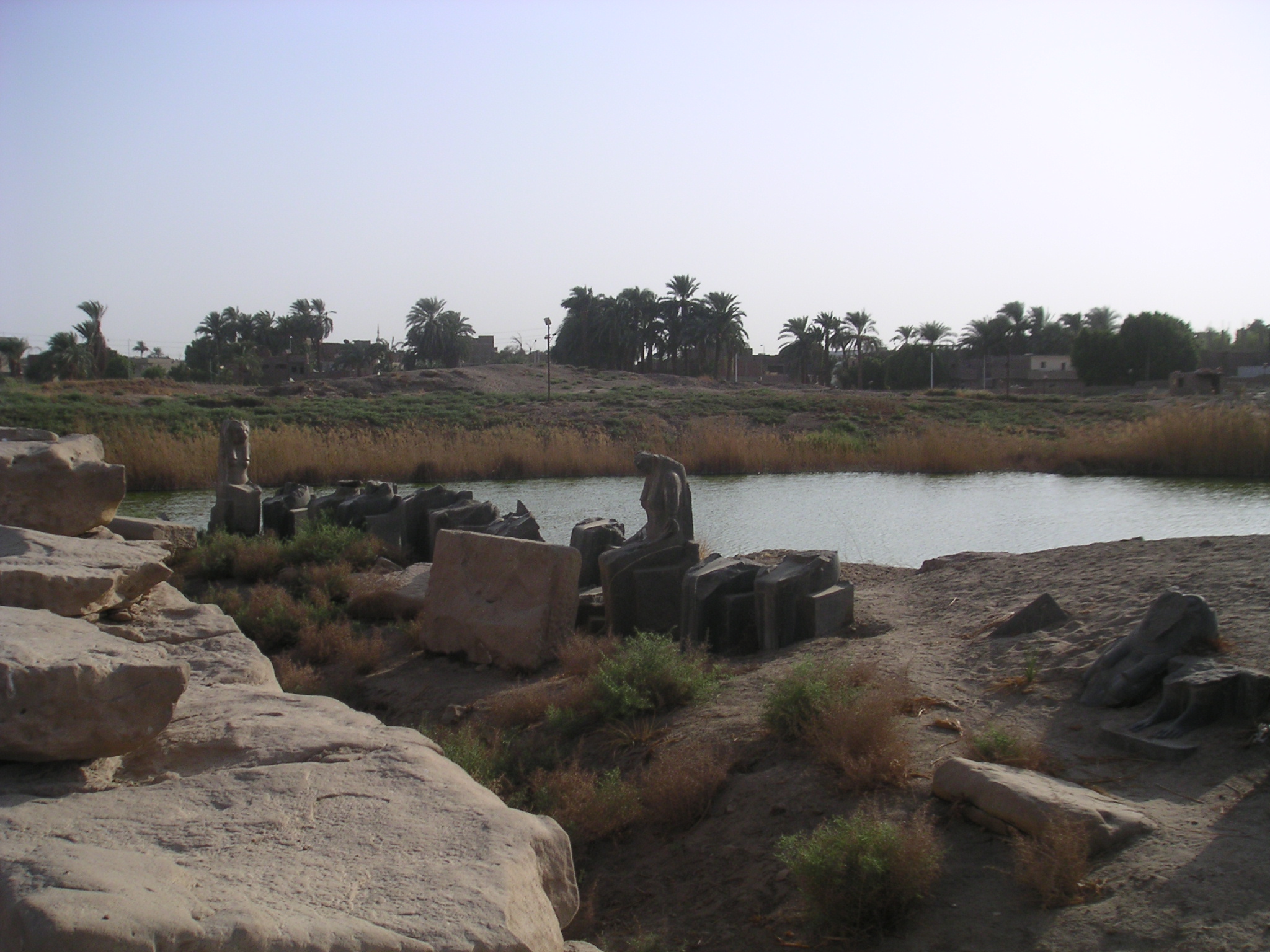
Most visitors walk past Sekhmet's statues at Karnak without knowing they are standing in front of one of the most psychologically complex deities in human history — a goddess who could destroy a civilization and heal it in the same breath. She is not merely a war goddess, and she is not simply a healer. She is the demonstration that these two forces — the capacity to wound and the capacity to mend — are not opposites. They are the same power, held in the same hands, directed by the same will. Understanding Sekhmet goddess Egypt means understanding one of the deepest ideas ancient Egypt ever produced: that true power is never one-dimensional.
Who Was Sekhmet?
Sekhmet (from the ancient Egyptian sḫmt, meaning "the powerful one") was one of the most formidable deities in the entire Egyptian pantheon. She appeared as a lioness — or as a woman with a lioness's head — wearing a solar disc crowned with the uraeus cobra. She was the daughter of Ra, the supreme solar deity, and she served as his Eye: his instrument of divine will when that will turned to fire and destruction.
She was the goddess of war, of plague, of the scorching desert wind, and of the fierce midday sun. She was also the patroness of physicians, the healer of wounds, and the deity called upon to drive pestilence away from cities and families. Her name appears in texts as early as the Old Kingdom (c. 2686–2181 BCE), already fully formed — not a minor local spirit but a cosmic force at the very center of Egyptian theology.
In her physical manifestation across Egypt's temples, she is almost always shown with a fierce dignity: seated on a throne, the solar disc gleaming, her expression calm and absolute. Not rage, but power so complete it has no need to perform itself.
Sekhmet at a Glance
- Name meaning: "The Powerful One" (ancient Egyptian: sḫmt)
- Appearance: Lioness, or woman with lioness head, solar disc, uraeus
- Parentage: Daughter of Ra; consort of Ptah of Memphis
- Domains: War, fire, disease, healing, medicine, solar power
- Cult centre: Memphis; also prominently worshipped at Luxor/Karnak
- Priest-physicians: The swnw — Sekhmet's healers — were Egypt's doctors
- Key myth: The Destruction of Mankind and the Beer of Forgetfulness
- First attested: Old Kingdom, c. 2686 BCE; fully formed in all major texts
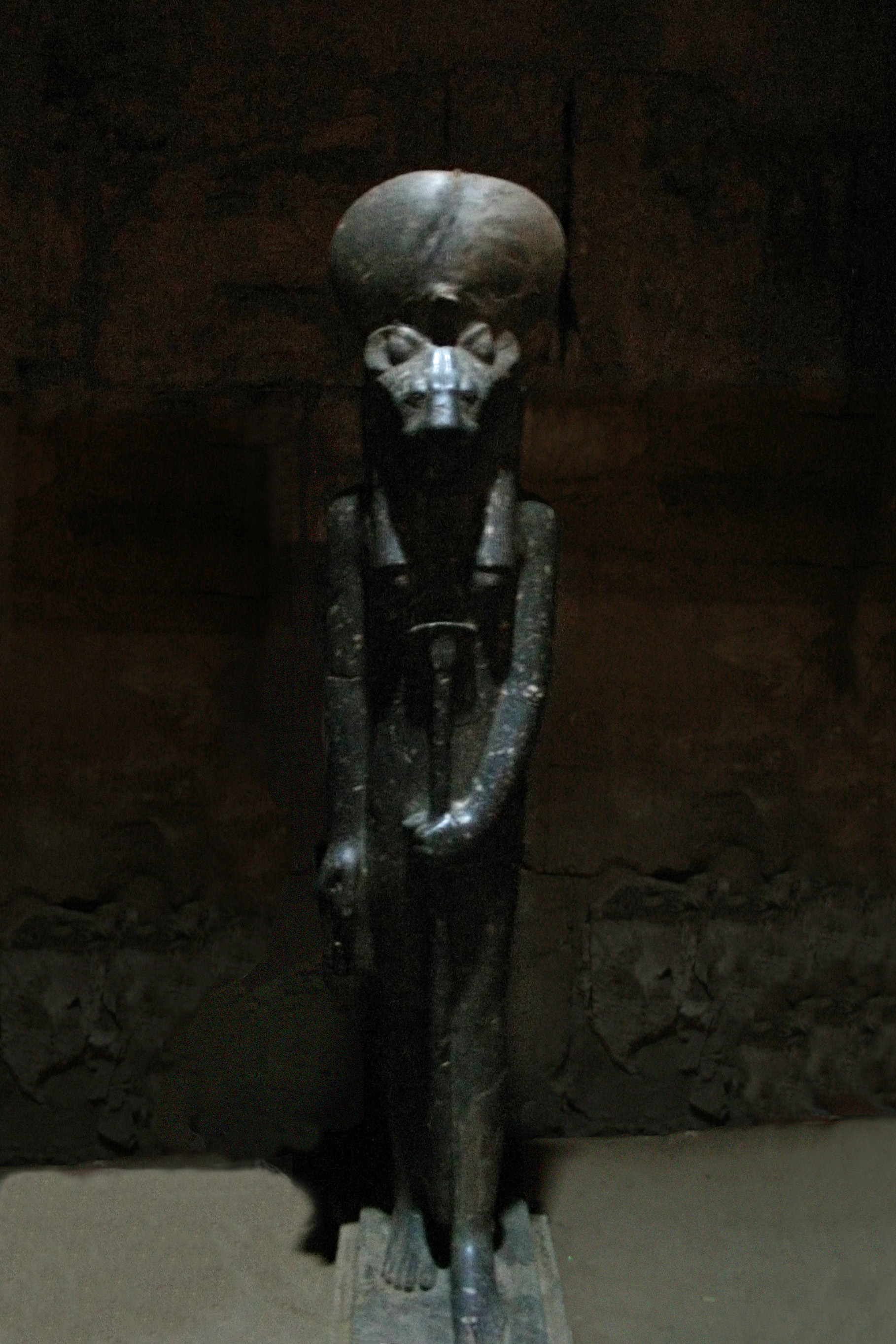
A Sekhmet statue inside the Temple of Ptah chapel at Karnak — one of hundreds commissioned by Amenhotep III, still standing in her original sanctuary.
Photo: Asavaa · CC BY-SA 3.0 · Wikimedia Commons
The Myth: Ra's Wrath and the Beer That Saved Humanity
The most dramatic of Sekhmet's stories — preserved in New Kingdom texts from the temples of Dendera, Edfu, and the tombs of the Valley of the Kings — begins in cosmic crisis. Ra, the sun god and ruler of all creation, grew old. His body weakened, his authority wavered, and humanity, sensing the shift, began to turn against divine order. Rebellion spread across the earth like a desert fire.
Ra's eye saw this. The eye of Ra — his instrument of solar vengeance — ignited with rage and took the form of Sekhmet. She descended upon humanity with the efficiency of a force of nature: no hesitation, no mercy, no satiation. She tore through the world drinking blood, and with each hour she grew stronger and more relentless. This was punishment, yes — but punishment was becoming annihilation. She was going to kill every human being on earth, and she could not stop herself.
Ra, watching in growing horror, realized he had set something in motion that even he could not simply halt. So he devised a stratagem born of deep understanding. He ordered his priests to brew seven thousand jars of beer and mix them with ochre and pomegranate juice until the liquid ran red as blood. Through the night, they poured this false sea across the killing fields where Sekhmet hunted.
At dawn she found it — a vast red flood stretching to every horizon. She drank. Deeply. Believing it was blood, she consumed jars and jars until the beer's sweetness overwhelmed her rage. She became intoxicated, the killing fury dissolved, and she woke transformed: gentle, confused, and peaceful. She became Hathor. Humanity survived, by the narrowest of margins, because someone understood what Sekhmet actually needed.
This is not merely a dramatic tale. It is a theological statement: the forces that destroy cannot simply be suppressed or defeated. They must be redirected. They must be understood. And the knowledge required to redirect them — the knowledge the priests possessed — was inseparable from the knowledge of healing.
Sekhmet and Hathor: Two Faces of One Force
Sekhmet and Hathor are among the most intimately linked deity pairs in the entire Egyptian system — not two separate goddesses so much as two states of a single divine feminine power. Hathor governs love, beauty, music, fertility, and joy. Sekhmet is her shadow: the same energy in its most fierce, unleashed form.
The myth of Ra's wrath makes this explicit: Sekhmet, soothed by beer, becomes Hathor. But this transformation runs in both directions. In certain ritual contexts, Hathor was invoked as "the raging one" and given Sekhmet's attributes. Temple iconography across Egypt shows the two goddesses exchanging symbols — Sekhmet holding Hathor's sistrum, Hathor wearing the solar disc and uraeus that mark Sekhmet.
The ancient Egyptians were not confused about this. They were expressing something sophisticated: that the full range of the feminine divine encompasses both nurture and destruction, and that any attempt to honour one while suppressing the other is incomplete and, ultimately, dangerous. Sekhmet's ferocity and Hathor's tenderness are not contradictions — they are the full picture.
When you stand in Karnak's dim sanctuary, surrounded by Sekhmet's stone faces looking out in every direction, you are standing inside this idea made architecture. Here is power that has been given form, contained, acknowledged, and honoured.
Sekhmet and Bastet: The Feline Spectrum
If Sekhmet and Hathor represent two energetic states of the same force, then Sekhmet and Bastet tell a story about the relationship between the wild and the domestic. Bastet — today's familiar cat goddess of the home, fertility, and protection — began her theological life as a lioness, fierce and war-like, closely related to Sekhmet. Over centuries, as Egypt's culture shifted, Bastet softened into the domestic cat: still protective, still sharp-clawed, but aligned with the hearth rather than the battlefield.
The progression from Sekhmet to Bastet can be read as a myth about civilization itself. In the open desert, under the scorching sun, the great cat is Sekhmet — untameable, serving cosmic law. In the ordered world of Egyptian home and city, that same energy finds expression as Bastet — contained, beneficial, protective of the family unit. Neither is superior. Both are necessary. And both draw their power from the same ancient root: the leonine divine, Egypt's most potent image of focused, purposeful force.
Sekhmet as Goddess of Healing: Egypt's Sacred Paradox
Here is the apparent contradiction that becomes, on reflection, perfect sense: Sekhmet's priests were Egypt's physicians. The swnw — "physicians of Sekhmet" — were the ancient world's most sophisticated healers, practising surgery, pharmacology, and complex wound treatment at a level not surpassed in the Mediterranean world for centuries.
The theological logic was iron-clad: Sekhmet could send plague, so she could also withhold it. She could wound, so she understood wounds. To invoke her was to access the knowledge of destruction — which was also, necessarily, the knowledge of how to undo it. Her temples functioned as healing sanctuaries. Pilgrims brought their diseases to her, laid offerings at her feet, and breathed the dark, incense-heavy air of her inner chambers. The priests, trained in both ritual and medicine, administered treatment and intercession simultaneously.
This is Sekhmet's deepest meaning for modern travellers: she is not a primitive war goddess but an embodiment of a genuinely sophisticated insight. The doctor who understands how disease destroys the body is also the one best equipped to stop it. Power without its shadow is incomplete. Sekhmet holds both sides of the equation — and her temples were built to honour exactly that wholeness.
Why Sekhmet Still Matters
Visitors who approach Sekhmet as a war goddess miss the point. Those who approach her as a healer goddess miss half the point. She is the demonstration that destruction and healing are not opposites — they are the same knowledge, the same power, expressed differently. Egypt's priests understood this 4,500 years ago. Modern visitors who take time to sit with her statues at Karnak often describe something they can't quite articulate: a feeling of being seen by something very old, very patient, and very complete.
Where to See Sekhmet Goddess Egypt Today
Sekhmet's statues and representations are distributed across Egypt, from Luxor's great temple complexes to Cairo's museum halls. Each site offers a different encounter with her presence.
| Site | Location | What You'll Find | Best Combined With |
|---|---|---|---|
| Karnak Temple Complex | Luxor, Upper Egypt | Hundreds of black granite Sekhmet statues in the sanctuary of Amenhotep III — one of the most haunting collections of ancient statuary on earth. Many are still in their original positions. | Luxor Temple, Avenue of Sphinxes, Valley of the Kings |
| Luxor Museum | Luxor, Upper Egypt | Several beautifully displayed Sekhmet statues in expert lighting, with full archaeological context and clear exhibition labels. Ideal for understanding the iconography before visiting Karnak. | Karnak evening sound & light show, Luxor Temple at night |
| Dendera Temple Complex | Between Luxor & Cairo, Qena Governorate | Sekhmet representations in the inner chambers, including healing ritual inscriptions. One of Egypt's best-preserved temple complexes, with stunning zodiac ceiling reliefs. | Abydos Temple of Seti I (same day trip from Luxor) |
| Egyptian Museum, Cairo | Tahrir Square, Cairo | Multiple Sekhmet statues across the collection, including New Kingdom examples, within the full context of the Egyptian pantheon. Grand Egyptian Museum also holds relevant pieces. | Giza plateau, Grand Egyptian Museum |

An 18th Dynasty Sekhmet statue at the Egyptian Museum of Turin — granodiorite, commissioned by Amenhotep III (c. 1391–1353 BCE). One of over 600 made for Karnak's sanctuary, now distributed across the world's great museums.
Photo: Prof. Mortel (Richard Mortel) · CC BY 2.0 · Wikimedia Commons
Karnak's Sekhmet Sanctuary: What to Expect
Nothing in Egypt quite prepares you for Karnak's Sekhmet sanctuary. Amenhotep III commissioned somewhere between 600 and 700 black granite statues of Sekhmet for this sacred space — one for every day of the year, and then some, to ensure her presence was continuously invoked across every ritual cycle. Many are still there. You walk among them in the dim light, their faces looking out from every angle, their solar discs catching whatever light filters through. It is not frightening — it is something more interesting than frightening. It is the feeling of being surrounded by something very ancient and entirely undimmed by time.
The sanctuary is sometimes kept locked. A licensed Egyptologist guide can arrange access and, more importantly, can tell you which statues date to Amenhotep III's original commission and which were added later, how the healing rituals were conducted in this space, and what specific epithets appear on the inscriptions you are standing next to. Without that context, you are looking at stone. With it, you are reading 3,400 years of human engagement with the idea of divine power.
Planning Your Sekhmet Journey in Egypt
Luxor is the heart of any meaningful Sekhmet itinerary, and it rewards at least two full days — three if you also want to visit Dendera and Abydos on a day trip from the city. The best visiting season runs from October through April, when temperatures sit between 20–28°C and the afternoon light on Karnak's sandstone turns amber and deeply photogenic. Summer visits are possible with careful scheduling (very early mornings, air-conditioned museums mid-day) and offer notably quieter sites.
Arrive at Karnak at opening time — 6am in winter months — to experience the sanctuary in relative quiet before the convoy tours arrive. Wear comfortable shoes: the temple complex is enormous and much of the ground is uneven ancient stone. A scarf or light layer is useful in the dim inner chambers, which maintain a surprisingly cool temperature even in warm weather.
If your interest in Egypt has a spiritual or mythological dimension, we design private itineraries built around exactly this kind of focused experience. Rather than a general highlights tour, we craft a journey through the sites and ideas that matter to you — moving through Karnak's sanctuary, the Luxor Museum, Dendera, and the West Bank sites as a coherent conversation about power, healing, and the Egyptian understanding of the divine.
Practical Tips for Visiting Sekhmet's Temples
- Best time: October to April — comfortable temperatures, golden light
- Karnak hours: 6am–7:30pm (winter); 6am–9pm (summer)
- Sanctuary access: Sometimes locked — book a licensed guide in advance
- Photography: Permitted throughout most of Karnak; no flash in enclosed spaces
- Dress code: Shoulders and knees covered (lightweight fabrics are best)
- Combined ticket: Karnak + Luxor Temple tickets can be purchased together
- Guide tip: A specialist Egyptologist guide transforms the experience from sightseeing to genuine understanding